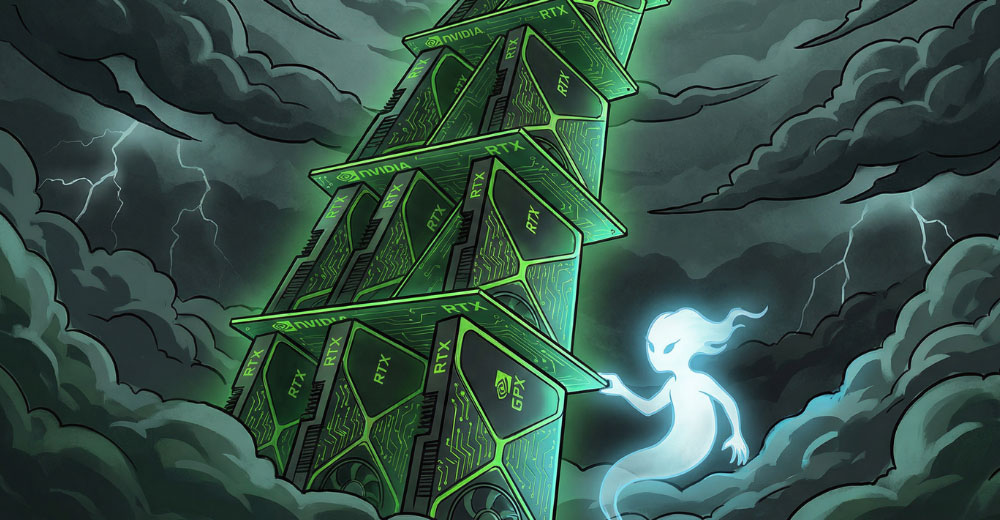
The air is getting thin up here. Nvidia recently shattered records by reaching a staggering $5 trillion valuation. It is a number that defies gravity, logic, and, historically speaking, sustainability.
But if you look closely at the pillars holding up this massive financial edifice, you’ll see they aren’t made of superior silicon or magical AI dust. They are built on a foundation of software lock-in known as CUDA. Thanks to a small, virtually unknown company named Spectral Compute, that foundation is about to turn into sand.
We are standing on the precipice of a massive correction in the AI market, one that will likely see Nvidia’s valuation stripped down to reality. The catalyst isn’t a better chip from AMD or Intel; it is a piece of code that makes the hardware irrelevant.
Let’s talk about how Spectral could bring down Nvidia’s house of cards. Then, I’ll close with my Product of the Week: HP’s OmniBook 5 Laptop 16″ AI PC.
CUDA Prison
How did Nvidia get to five trillion dollars? It wasn’t just by selling GPUs. If this were purely a hardware race, AMD and Intel would have eroded the margins years ago. Nvidia reached this height by creating a walled garden so high and so thick that developers felt they had no choice but to stay inside. CUDA (Compute Unified Device Architecture) is that wall.
For over a decade, Nvidia has aggressively pushed CUDA as the only viable language for accelerated computing. Nvidia gave it away to universities, hooked researchers early, and ensured that the entire AI software stack — from PyTorch to TensorFlow — ran natively and best on Nvidia green. The result was a classic monopoly strategy: lock the customer in so tightly that the cost of leaving is higher than the cost of staying, no matter how abusive the pricing becomes.
Investors looked at this moat and saw infinite returns. They didn’t value Nvidia as a hardware company; they valued it as the owner of the AI standard. However, monopolies built on coercion rather than preference are notoriously fragile.
Blackwell Warning Signs
The cracks in the armor are already visible, and they are coming from the very top of the food chain. Microsoft, arguably Nvidia’s most important customer, has effectively sounded the alarm.
Microsoft CEO Satya Nadella has been increasingly vocal about the logistical nightmares associated with Nvidia’s latest hardware. While diplomatically phrased, his recent comments about having “chips sitting in inventory that I can’t plug in” highlight a critical failure in Nvidia’s roadmap. The Blackwell architecture, touted as the next leap forward, has been plagued by overheating issues and massive power requirements that existing data center infrastructure simply cannot support.
When your biggest customer tells you that your product is effectively unusable in the current environment, a listening company pivots. A company drunk on its own lock-in power, however, tends to double down. Microsoft has reportedly cut orders for Blackwell racks, signaling that the pain of staying with Nvidia is finally starting to outweigh the fear of leaving.
Enter Spectral: The Key to the Jail Cell
While the giants fight over power grids and heat dissipation, a small British startup, Spectral Compute, has quietly forged the key to the CUDA prison.
Almost no one has heard of Spectral. It doesn’t have flashy keynotes or leather-jacketed CEOs. What it has is a technology called Scale, a “C to silicon” compiler that allows CUDA applications to run natively on AMD hardware — and eventually on other hardware — without porting, without performance loss, and without the headaches that have plagued previous conversion attempts.
This isn’t vaporware. Spectral’s technology is working today. For the first time, a company can run a massive library of legacy CUDA code on AMD’s MI300 or upcoming MI400 chips by simply recompiling.
This changes the math entirely. If CUDA code can run on any hardware, Nvidia’s “moat” evaporates. The hardware becomes a commodity again, and commodities do not trade at 40x revenue.
The Migration Has Begun
Spectral isn’t the only one swinging a sledgehammer at the wall, though it may have the sharpest tip. There is a quiet army of major and minor players working on breaking CUDA’s grip.
Microsoft has been developing toolkits to convert CUDA to ROCm, aiming to leverage its massive investment in AMD silicon. AMD has its HIP (Heterogeneous-Compute Interface for Portability) and HIPIFY tools. There are open-source projects, like the recently resurrected Zluda, attempting similar feats.
The difference with Spectral is the seamlessness. If it succeeds in making the transition invisible, the floodgates will open. CIOs, currently sweating over Nvidia’s extortionate pricing and delivery delays, will look at AMD’s comparable performance at half the price and realize they finally have a choice.
The Arrogance of Lock-In: Lessons From IBM
I have seen this movie before. In fact, I had a front-row seat.
Working at IBM in the 1980s, I saw the same hubris that currently permeates Nvidia. IBM’s leadership genuinely believed that the customer’s opinion didn’t matter. We weren’t just selling mainframes; we were, as one executive famously put it, “selling air.” The implication was that our customers needed us to breathe. They were locked into our architecture, our software, and our service contracts. We believed they had nowhere to go.
This arrogance creates a culture of deafness. When you believe your customers are captives, you stop listening to their complaints about price, complexity, or power consumption. You stop treating them as partners and start treating them as resources to be mined.
At IBM, this strategy laid the groundwork for the company’s near-collapse in the early 1990s. The moment the market offered a viable alternative (client-server computing), the exodus was violent and rapid. Customers didn’t just leave; they fled with a vengeance, angry at years of being taken for granted. Nvidia is currently generating that same level of resentment among the hyperscalers and enterprises that feed it.
The Fallout: When $5 Trillion Evaporates
So, what happens when the correction hits?
If Spectral’s technology gains traction — and I believe it is a matter of when, not if — Nvidia’s stock won’t just dip; it will crater. A valuation of $5 trillion implies total domination for decades. The realization that it is just another hardware vendor in a competitive market could easily wipe 50% to 70% off Nvidia’s market cap overnight.
This will send shockwaves through the tech sector. The AI bubble, inflated largely by Nvidia’s multiplier effect, will burst. Companies that leveraged themselves to buy H100s and Blackwells will see their asset values plummet.
But the most immediate human toll will be inside Nvidia itself.
Right now, thousands of Nvidia employees are paper millionaires or billionaires. They are “resting and vesting,” meaning they are waiting for their stock options to mature. A massive correction turns those options from lottery tickets into confetti.
When a workforce that expects to retire at 35 suddenly realizes they have to work for another 20 years, morale doesn’t just drop; it disintegrates. The talent drain that follows will further accelerate the company’s decline, creating a death spiral that is incredibly difficult to pull out of.
Wrapping Up
We are in the calm before the storm. The technology to break Nvidia’s monopoly exists. The customer resentment required to drive adoption is at an all-time high. The specific technical failures of the Blackwell generation have provided the opening.
I expect Spectral’s power to pivot this market will become widely known within the next two quarters. Once a major player — likely Microsoft or Meta — publicly announces they are shifting a significant portion of their production workload to AMD using Spectral’s Scale, the illusion of Nvidia’s invincibility will shatter.
The market correction will be brutal, but it is necessary. It will return competition to the chip industry, lower AI development costs, and serve as a harsh history lesson that, in technology, no wall is high enough to keep the future out forever.
HP OmniBook 5 16″ Laptop AI PC
The Best Laptop Value of the Holiday Season
Navigating the chaotic sea of Black Friday and Cyber Week deals can be exhausting. Often, the “doorbuster” specials are older models, refurbished units, or devices so underpowered they struggle to run a web browser and a spreadsheet simultaneously. However, every once in a while, a deal surfaces that forces you to double-check the price tag. This season’s standout is the HP OmniBook 5 Laptop 16” AI PC.
For the holiday shopping season, HP has aggressively positioned the OmniBook 5 to capture the mainstream market, offering configurations that are arguably the best consumer values in the laptop space right now.
16” Screen Advantage
Historically, the laptop market has been segmented by size and price. If you wanted a budget laptop (under $500), you were generally relegated to 13” or 14” screens. If you wanted a 16” or 17” display — often preferred for the “desktop replacement” experience — you had to pay a premium for the extra glass and chassis materials.
The OmniBook 5 disrupts this pricing structure.
A 16” screen is incredibly useful for a variety of reasons. It offers enough real estate to have two full-sized windows open side by side, which is essential for productivity. For entertainment, it provides a far more immersive streaming experience than smaller notebooks. Furthermore, for users with aging eyes, the larger screen allows for increased font scaling without losing too much context on the page. Getting this form factor at these price points is highly unusual.
Configurations and Sub-$400 Pricing
HP offered three distinct tiers of discounts during Black Friday and Cyber Week, when I wrote this column, making this machine accessible to almost anyone.
The Powerhouse Configuration (16-af1037nr)
The star of the lineup is the AI-enabled configuration. It features the Intel® Core™ Ultra 7 255U processor, which includes 12 cores and 14 threads, capable of speeds up to 5.2 GHz. This isn’t a budget chip; it’s a high-performance engine designed for heavy multitasking.
- Display: 16” diagonal, 2K (1920 x 1200), touch, IPS, 300 nits.
- Battery: Up to 16 hours of video playback.
- Price: Dropped to $629.99 starting back on Black Friday (down from over $1,000).
Getting a Core Ultra 7 machine with a 2K touch display for just over $600 is a standout bargain.
The Customizable Value Kings
Where things get truly disruptive is with the customizable SKUs.
- Intel Core Ultra SKU: Starting at $529.99 on Cyber Monday. This gets you into the AI PC ecosystem for nearly half the price of competitors.
- Intel Core i5 SKU: This is the shocker. On Black Friday and Cyber Monday, this configuration started at $379.99.
To find a brand-new 16″ laptop from a tier-one manufacturer like HP for under $380 is exceptionally rare. That price point is usually reserved for Chromebooks or low-end Celeron-based Windows machines, not devices equipped with Core i5 processors.
Who Is the OmniBook 5 For?
Because of the pricing spread, the OmniBook 5 fits several demographics perfectly:
- Students: The 16″ screen is perfect for dorm rooms where a separate monitor isn’t an option, and the battery life lasts a full day of classes.
- Home Office Workers: The Core Ultra configurations handle Zoom, Excel, and heavy browsing with ease, and the NPU (neural processing unit) future-proofs the device for AI workloads.
- Seniors and Casual Users: The entry-level $379 model is ideal for those who primarily do banking, email, and social media but want a large, bright screen that is easy to read.
Design and Sustainability
Beyond the specs, HP continues its push for sustainability. The OmniBook 5 is constructed using recycled metals and post-consumer recycled plastics. It features a modern design with a micro-edge display and includes the dedicated Copilot key, offering instant access to Microsoft’s AI assistant — a feature that is becoming standard on premium devices but is a welcome addition at this price tier.
Final Thoughts on the OmniBook 5
We are accustomed to paying a “screen tax” for larger laptops, but HP has effectively eliminated that barrier this season. Whether you opt for the high-performance AI model or the incredibly affordable entry-level SKU, you get a premium chassis and a massive display for a fraction of the expected cost. Because it brings the productivity benefits of a 16” display to a price point accessible to almost everyone, the HP OmniBook 5 16” Laptop is my Product of the Week.
The images featured in this article were created with AI.