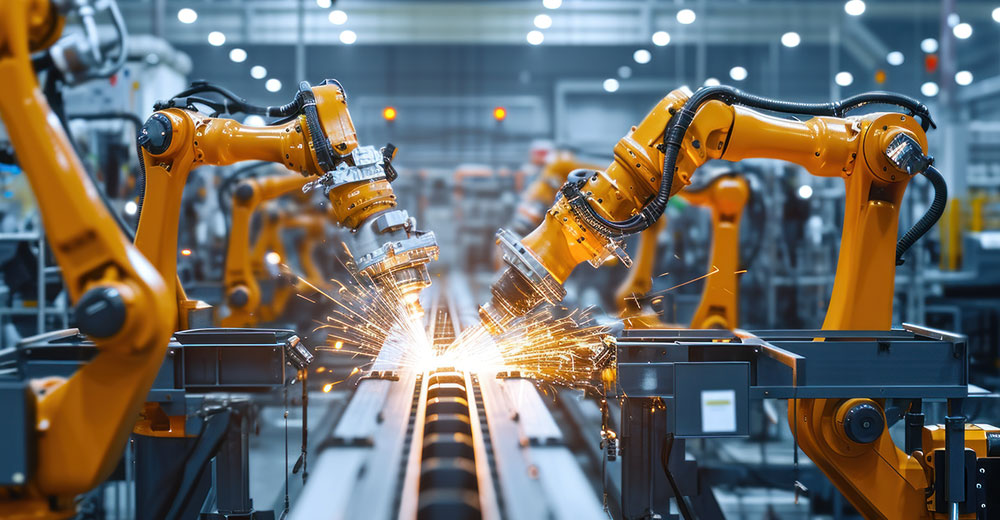
As the Trump Administration mulls slapping tariffs on foreign robotics, it’s being warned that such a move could disrupt efforts to revive manufacturing in the United States.
The U.S. Commerce Department has begun collecting comments in an investigation authorized by section 232 of the Trade Expansion Act of 1962, which allows the agency to impose trade restrictions — such as tariffs or quotas — if imports are found to impair national security.
Opponents of tariffs, however, argue that the levies on foreign robotics would not only undermine national security but also hobble efforts to revive the U.S. manufacturing sector.
“This increased expense on essential automation tools would squeeze profit margins, especially for small-to-mid-sized firms, making their final products more expensive compared to international rivals who can acquire the same technology tariff-free,” he told TechNewsWorld.
“Essentially, tariffs could delay or derail the push to increase productivity and reshore manufacturing, undermining the very renaissance they are meant to protect,” he added.
Threat to Manufacturing’s Backbone
Seil Kim, vice president of DN Solutions, a South Korean manufacturer of computer numerical control (CNC) and metal-cutting machine tools, and Daniel Medrea, executive vice president of DN Solutions America, a U.S. subsidiary established in 1994, pointed out in comments submitted to Commerce that while large corporations often capture headlines, the backbone of American manufacturing consists of thousands of small and medium enterprises.
“These companies, often family-owned job shops, depend on access to affordable, high-quality machine tools to remain competitive,” they stated.
“For many small manufacturers, purchasing a CNC machine represents a major capital investment that must deliver returns for decades,” they explained. “They need equipment that is not only capable but also supported by readily available service, training, and spare parts.”
“Imposing tariffs or restrictions on our equipment would place these critical capabilities out of reach for many small businesses, forcing them either to delay modernization or to seek lower-quality alternatives that could compromise their competitiveness,” they maintained. “The changes in price competitiveness could also increase the likelihood of substitution with lower-cost Chinese products, potentially posing a security threat.”
American companies need robots to lower labor costs, increase productivity, and assure factory uptime, added Rob Enderle, president and principal analyst of the Enderle Group, an advisory services firm, in Bend, Ore.
“In addition, existing robots become obsolete or wear out, and it is easier to replace robots with those from the same manufacturer than to switch providers,” he told TechNewsWorld.
Passing Tariffs to Buyers
Tariffs will also put U.S. manufacturers at a disadvantage when purchasing equipment in global markets. “Tariffs are most typically passed on to the buyer,” explained Enderle. “Given the robot market is very competitive, making margins largely too tight to absorb much in the way of tariffs.”
Vena agreed that it is highly unlikely that foreign robotics companies will significantly cut prices to absorb the full cost of a U.S. tariff. “This is because manufacturers in key producing nations like Japan and Germany have strong, growing markets elsewhere and have diversified their global sales, making them less reliant on U.S. market access,” he explained.
“There’s a lot of interest in these products globally,” added Paul Steidler, a senior fellow at the Lexington Institute, a public policy think tank in Arlington, Va.
“This is not some stale old school commodity product where tariffs may have some beneficial impact,” he told TechNewsWorld. “A lot of these robots are highly specialized.”
“Tariffs are just going to up the price and cost for U.S. manufacturers, and that’s going to impair productivity and manufacturing growth significantly,” he said.
Domestic Production Insufficient
Ed Brzytwa, vice president of international trade, and Michael Petricone, senior vice president of government affairs, at the Arlington, Va.-based Consumer Technology Association (CTA), which represents more than 1,200 member companies in the U.S. technology industry, concurred that tariffs on robotics and industrial machinery — products that constitute critical inputs in manufacturing — would significantly increase costs for equipment and machinery on factory floors, discourage investment into new U.S. production capacity and threaten jobs.
“This is underscored by the fact that domestic production of critical inputs alone is insufficient to sustain the needs of U.S. manufacturers,” they wrote in comments to Commerce. “Currently, even if operating at full capacity, the U.S. manufacturing industry could only produce 84% of the inputs manufacturers need for production. Thus, 16% of manufacturing inputs must be imported in order for U.S. manufacturers to operate.”
“In fact, in key sectors such as automotive manufacturing, domestic suppliers of critical machinery for manufacturing and assembly already suffer from overcapacity, illustrating the reality that current U.S. supply cannot meet growing demand for advanced machinery,” they continued.
“Subjecting robotics and industrial machinery to tariffs would further prevent U.S. manufacturers from building, modernizing, and operating facilities,” they added.
The CTA urged Commerce to exclude industrial robots, industrial machinery, automated guided vehicles (AGVs), and other complete computer-controlled mechanical systems, including LiDAR modules, from any trade action. These technologies are critical to U.S. industrial capacity, enable reshoring, and support globally competitive production.
Because production lines have been optimized around these systems, replacing them would require years of reengineering, in turn delaying domestic investment and manufacturing expansion, the CTA added.
Boosting Domestic Robotics
Vena pointed out that the U.S. currently lacks the domestic capacity to produce all the industrial robots needed for its manufacturing base.
“An estimated 80% of robots bought in the U.S. are manufactured overseas, primarily in countries like Japan, Germany, and China,” he explained. “This trend is partly a legacy issue, as countries like Japan and Germany historically excelled at producing the specialized, high-precision machine tools required to make these robots.”
“Since the U.S. does not have the capacity to meet demand, tariffs would raise costs without providing a viable domestic alternative,” he added.
He noted that several initiatives have been launched to increase the number of robots produced in the United States. “Programs like the National Robotics Initiative — known as NRI 3.0 — and the Advanced Robotics for Manufacturing Institute invest in R&D and public-private partnerships,” he said.
“Additionally, broader acts like the CHIPS Act and the Bipartisan Infrastructure Law include funding that indirectly supports the advanced technologies and facilities critical to the robotics ecosystem.”
Steidler recommended that the U.S. court Japan and its robot companies to invest directly in the U.S. and to make joint investments with U.S. companies for robot development here. “Japan is a leader in manufacturing here,” he said. “They’re a good friend, a good ally of the United States, and they should be embraced on this.”
He also recommended adopting lower tax rates and faster depreciation of investments, as well as fostering a climate in which U.S. companies can acquire foreign robotics companies and bring their operations to the U.S., or find ways to work with them jointly.
“Those actions will have much more immediate and positive benefits than tariffs, which are likely to raise prices and create a lot of disruption here at home,” he added.